
How many restrooms does a county fair need?
Start with attendance, not acreage. Fair crowds move in waves, heaviest around midday and again after dinner, so you plan for the peak hour, not the daily total. A rough guide many event planners use is one toilet per 50 to 100 guests for a single-day event, then add units if alcohol or food trucks are on site, since both push bathroom trips up. Our how many porta potties do I need guide walks through the math for gate counts, but the fair grounds layout matters just as much as the number. Spread units across zones instead of clustering them at one entrance. That cuts walk time and keeps lines from backing into midway traffic. If the fair runs a beer garden or wine pour, put a cluster near that area specifically, since drink lines and bathroom lines tend to move together. Vendors cooking on site fall under different rules than general attendee sanitation, and if any of them are handling paints or coatings for booth signage rather than food, OSHA 1926.51(f)(1) requires washing facilities for that specific work, separate from what the crowd uses. For general attendee counts, OSHA 1926.51(c) sets the construction-site ratio backdrop that most event planners still reference as a floor. Antioch fairgrounds with limited water hookups also do well with a deluxe flushable unit or two near VIP or sponsor areas.
What restroom setup works best for a multi-day fair?
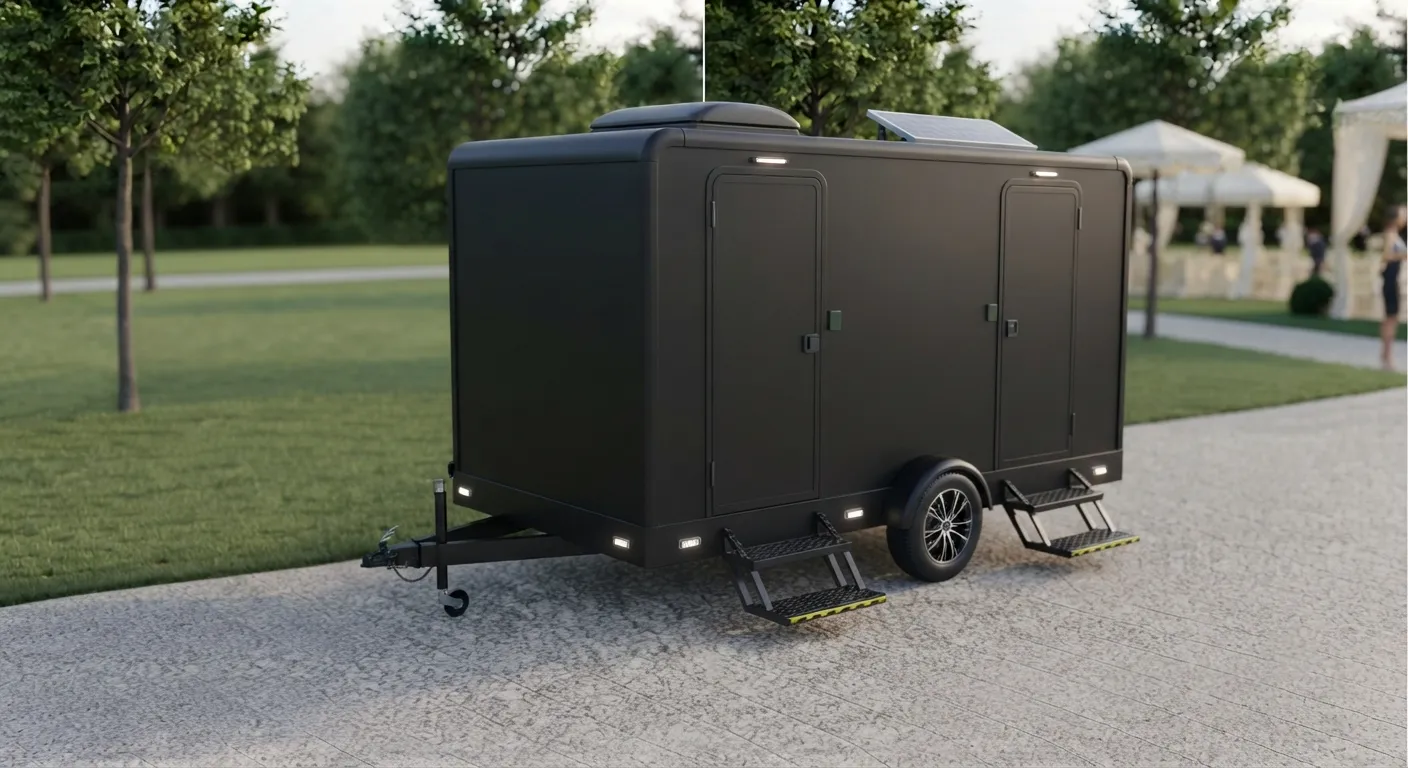
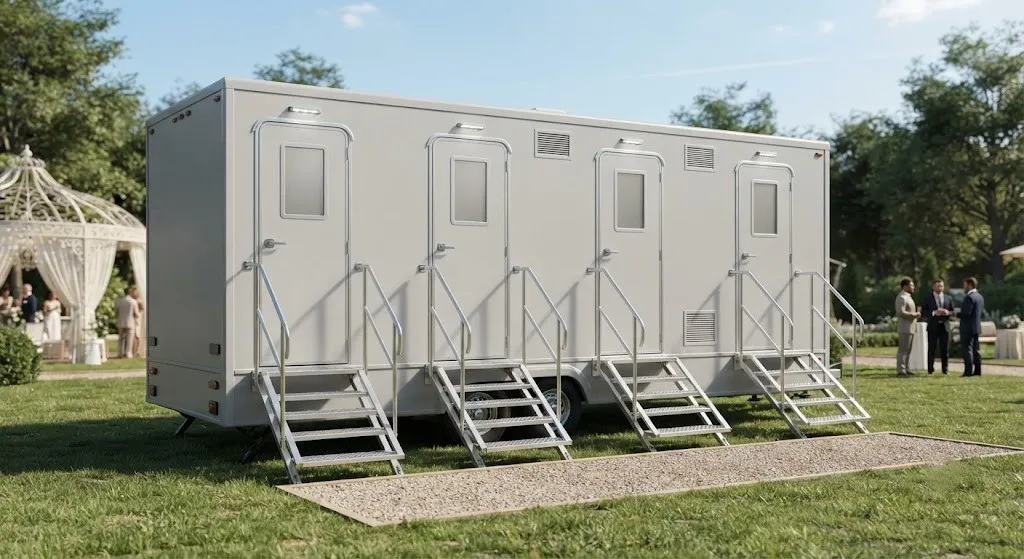
Multi-day fairs need a servicing plan built into the rental, not just a delivery and pickup. A standard unit carries a 60 to 70 gallon holding tank, and under steady fairground use that tank fills faster than it would at a construction site, so nightly or twice-daily service during the run keeps units usable through closing time. ANSI/PSAI Z4.3 sets a baseline service interval of once a week for up to 10 users over a 40 hour week, which tells you how far fairground use outpaces that baseline and why a service plan matters more than the unit count alone. For larger fairs with grandstand seating or a main stage, a restroom trailer rental gives guests flushing toilets and running water, which cuts complaints dramatically compared to a bank of standard units. An 8 stall restroom trailer handles heavy traffic near a main stage, while a 2 stall restroom trailer suits a smaller vendor row or a sponsor hospitality tent. Layout also needs to account for site access: roll-off dumpster service and restroom trailer delivery both need clear approach lanes, and a roll-off truck alone needs about 60 feet of straight clearance behind it to place the box. Fair organizers in Antioch working with a fixed grounds layout should confirm that clearance early, before trailers and dumpsters get boxed in by vendor setup.
Are ADA accessible restrooms required at a county fair?
Yes, and the standard is specific. ADA Standards section 213.2 requires that where single-user portable units are clustered, at least 5 percent of them be accessible, with a minimum of one unit regardless of cluster size. That means even a fair renting 15 or 20 standard units needs at least one ADA accessible porta potty in the mix, and larger fairs need more spread across zones so no guest has to cross the whole grounds to reach one. The accessible unit itself has to meet real dimensions: ADA Standards section 404.2.3 sets a 32 inch minimum clear door opening, and section 304.3.1 requires a 60 inch turning circle inside. Ground leading up to the unit also matters. ADA Standards section 302.1 requires the surface be stable, firm and slip resistant, which rules out loose gravel or soft turf as a pad for an accessible unit even if it is fine under a standard toilet. Fair organizers in Antioch placing units on grass fields should ask their vendor about placement pads specifically for the accessible unit's approach path. Our ADA restroom requirements page covers reach ranges and operable-parts rules in more depth. If your fairgrounds site sits close to Brentwood or Oakley, both about 7 to 9 miles from central Antioch, the same accessible-unit rules apply regardless of which side of the county line the gate sits on.
Frequently asked questions
How far in advance should we book county fair restrooms?
Book as soon as the fair date and expected attendance are set, ideally 60 to 90 days out for a weekend fair. Restroom trailers and larger unit counts get reserved early during fair season. Late requests still get handled through emergency porta potty rental, but selection narrows fast close to the date.
Do we need handwashing stations separate from the restrooms?
Yes, especially near food vendors. 29 CFR 1910.141(d)(2) requires washing facilities to have soap and towels or a hand drying device; sanitizer alone does not satisfy it. A portable sink rental or dedicated handwashing station rental placed at food row covers this cleanly.
What does a restroom trailer cost for a weekend fair?
Weekend restroom trailer rentals in this market typically run in the 900 to 3,000 dollar range depending on stall count and features. See restroom trailer rental cost for a full breakdown by trailer size and rental length.
Can we add fencing around the restroom area?
Yes. Temporary fencing keeps foot traffic organized and blocks off service access points from the general crowd. Check temporary fence rental or crowd control barrier rental depending on whether you need solid perimeter or crowd-flow barriers.
Who handles trash alongside the restrooms?
Most fairs pair restroom service with a roll-off dumpster rental for vendor and concession waste. A 10 yard dumpster rental covers a small single-day fair, while multi-day events with food vendors often need something larger.
Next step
Get a delivery date
Tell us the address, the dates and the headcount. We size the order and confirm the route.